Woman
Crimson LakeWoman is an injured domestic goose whose rescue brings Ted into an unexpected daily relationship of care. First encountered with six goslings near crocodile-infested marshlands, she is at once vulnerable and formidable: she limps, hisses, flaps, and snaps at anyone who comes close. Over time, her recovery and watchfulness make her more than an animal Ted has taken in. She becomes a distinct presence in his precarious home life, alert to dangers he misses and capable of accepting closeness on her own terms.
Identity and First Encounter
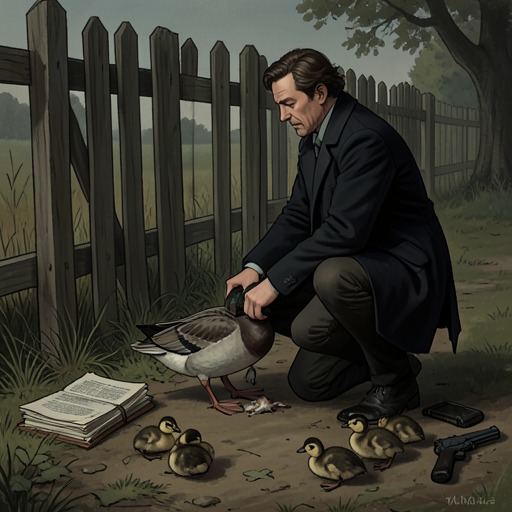
Ted initially mistakes Woman for a swan when he hears her strange, coughing squeak. She approaches from the other side of a fence, with little grey chicks scattering around her, then seems to reconsider and backs away, hissing and beating one great white wing. Her injured foot makes her movement uneven, but not passive: when Ted opens the gate and tries to gather her, she bites and scratches his nose, ear, and eyebrow, drawing blood. The chicks scatter and then follow her in a frantic row as he carries her into the yard.
The name Woman comes from Ted’s drunken exclamation during the journey to the vet, when the goose and chicks’ distress sounds overwhelm him. The name sticks, fixing her in his life not as an anonymous bird but as a member of the household. At the vet’s office, Ted tries to keep his distance while the vet examines her, and the bird snaps at the vet’s collar. Her injured leg is later braced. The treatment costs seven hundred dollars, leaving Ted with fifty-nine dollars and making him the new owner of a family of domestic geese.
Care and Growing Familiarity
Woman’s recovery unfolds through small, repeated encounters rather than a sudden transformation into a tame pet. On the porch, Ted lifts the towel covering the birds’ box and finds her asleep with her head tucked beneath her good wing. When he reaches beneath it to take a sleeping chick into his palms, she does not protest. Ted interprets the quiet night as a truce: his touch is allowed, but the moment does not erase her earlier wariness.
Later, rain makes the goslings too fragile to remain outside. Ted fills the bathtub with shallow water so they can swim, gathers them up in his T-shirt, and sits nearby reading Jake Scully’s first novel. Woman watches from the bathroom doorway while the chicks paddle, dive, and flap in the tub. Ted becomes absorbed in their play, smiling and taking out his phone to photograph one gosling’s somersault. The scene shows care taking shape as ordinary attention: making room for the birds, watching what they do, and responding to their needs.
Their familiarity remains conditional. When Ted reaches carefully to rub the top of Woman’s head, she does not flinch or snap, but he cannot know whether she remembers his kindness to one of her chicks or is simply tired. His attempt to describe them as building a relationship is met with a hiss. Later, she watches Ted gather the goslings from the bath without objecting. Trust appears in particular actions, not as a permanent surrender of her independence.
Watchfulness and the Python
Woman’s importance to the household becomes clearest when she reacts to a python on the porch roof. While Ted is inside, she repeatedly squeals, growls, and flaps against the back door. He initially treats the noise as a tantrum and goes about his routine; only after she continues does he hurry outside. A near-black diamond python lies along a roof beam, its body swollen around a recent catch. Ted checks the goslings and finds all six safe.
Her alarm gives Ted time to act, and he recognizes that her persistent warning may have prevented the snake from catching another bird. He improvises a snake catcher from twine threaded through the hollow handle of a plastic broom, draws the python down, and carries it away. The episode gives Woman an active role in the scene: she detects a danger Ted has failed to notice and keeps signaling until he responds. Her care for the young is expressed not through human speech but through the noise and movement that bring him outdoors.
Public Hostility and Shared Refuge
Woman remains beside Ted as the threat of human hostility enters the domestic space. After Ted has removed the python, reporter Fabiana arrives and sees that someone has hurled bright red paint across the front of the house, covering the door, boarded-up windows, and old brickwork. The paint runs down the building in lines Ted associates with prison bars. The contrast is sharp: moments earlier, Woman’s warning had helped protect the birds; now she stands in a home marked by a public attack against Ted.
During a later search of the house by Crimson Lake police, Ted waits on the porch as officers wreck his belongings inside. Amanda crouches beside Woman and puts an arm around her, stroking the large feathers of her good wing. Woman does not snap, though she remains alert and gives an anguished squeak at the sounds indoors. Amanda’s attention rests on the horizon, her eyes sad. The scene places the goose within a shared moment of distress without making her merely a prop: she responds to the intrusion in her own way, and the humans gather beside her amid the damage.
Character and Narrative Significance
Woman’s arc is defined by injury, care, and reciprocal vigilance. Ted first risks being bitten to bring her and the goslings inside; later, he tends to them through rain, gives them water in the bathtub, and learns to distinguish alarm from ordinary noise. In return, Woman’s warning about the python makes her protection of the household concrete. Their connection is neither sentimentalized as effortless affection nor reduced to ownership: she can resist touch, hiss at Ted’s claim of intimacy, and still permit closeness at other moments.
Her presence also changes the texture of Ted’s isolation. The injured bird and vulnerable goslings require practical attention, creating routines at a time when the porch and house are surrounded by danger and hostility. Yet Woman remains more than a device for making Ted seem compassionate. Her damaged leg, defensive responses, maternal attention, and ability to detect a threat give her a sequence of actions and needs that belong to her. Across the encounters, care becomes reciprocal without becoming equal: Ted provides shelter and treatment, while Woman’s alertness helps keep the family safe.